

This article is for a specific reader. If it is not for you, the article will know. If it is, the article will know that too.
You are the friend everyone calls when their world tips over. You are the sibling who handles the parents’ GP appointments. You are the colleague everybody goes to when their direct manager is hopeless. You are the de facto IT support for your family, the unofficial therapist for your friend group, and the person in your work team who actually replies to the emails on a Sunday.
You have spent your entire adult life being competent at someone else’s emergency.
The phrase people use about you, the one that is always meant as a compliment but lands as a sentence, is “just so capable.” You are so capable. She is so capable. We do not have to worry about her because she is just so capable. There is a tone of voice that goes with that phrase. It means “do not stop.”
The book is about the part nobody calls about.
Why most self-help misses this audience
Most self-help books are written for the person who is not coping. The reader who is in obvious distress. The reader whose problem is visible.
The strong one’s problem is not visible. That is the problem. The strong one’s burnout looks identical from the outside to the strong one’s competence. The person handling the Christmas roster while quietly disintegrating looks, on a Tuesday in November, exactly the same as the person handling the Christmas roster who is fine. Nobody knows the difference. Often the strong one does not know the difference either, until they sit down on a kitchen floor in May and realise they have not been okay since 2023.
Most self-help cannot reach this reader because the reader does not present as the audience the books are written for. They look like the helper, not the person who needs help. Self-help shelves are addressed to the obvious cases. The not-obvious cases walk past the section.
What the book is for
It is for the noticing. Not the fix. The noticing.
The thing that is hard for the strong one is naming the problem. The advice does not work without the naming first. The Strong One Is Tired is a book of nouns and sentences for things the reader has been doing for years and has never had a word for. Invisible labour. Carrying-shaped tiredness. The two-question test. The kind of exhaustion that does not fix itself with a weekend away because the tiredness is not sleep-shaped, it is carrying-shaped, and you can sleep for eighteen hours and wake up still carrying the same amount.
The book does not pretend it can put the load down for you. It says: here is what you are carrying. Here is which bit of it is yours. Here is which bit is not. That is the work. The work is the inventory. The next steps come after.
Who buys this book
Two readers. The first is the reader for themselves. They read the title on Amazon, the first paragraph of the description, and recognise themselves. They buy it on a Thursday at midnight. They are reading it on Saturday morning. They do not put it down until Sunday.
The second is the gift-buyer. The person who has finally noticed the strong one in their life. They buy the book to say the thing they cannot say out loud, which is: I see you. I know how much you carry. Please put some of it down. The book holds the conversation the gift-buyer was never going to have face-to-face.
Both are valid. The book serves both.
The line in the book that matters most
It is on the cover, more or less. The strong one is not fine.
That sentence is the whole book.
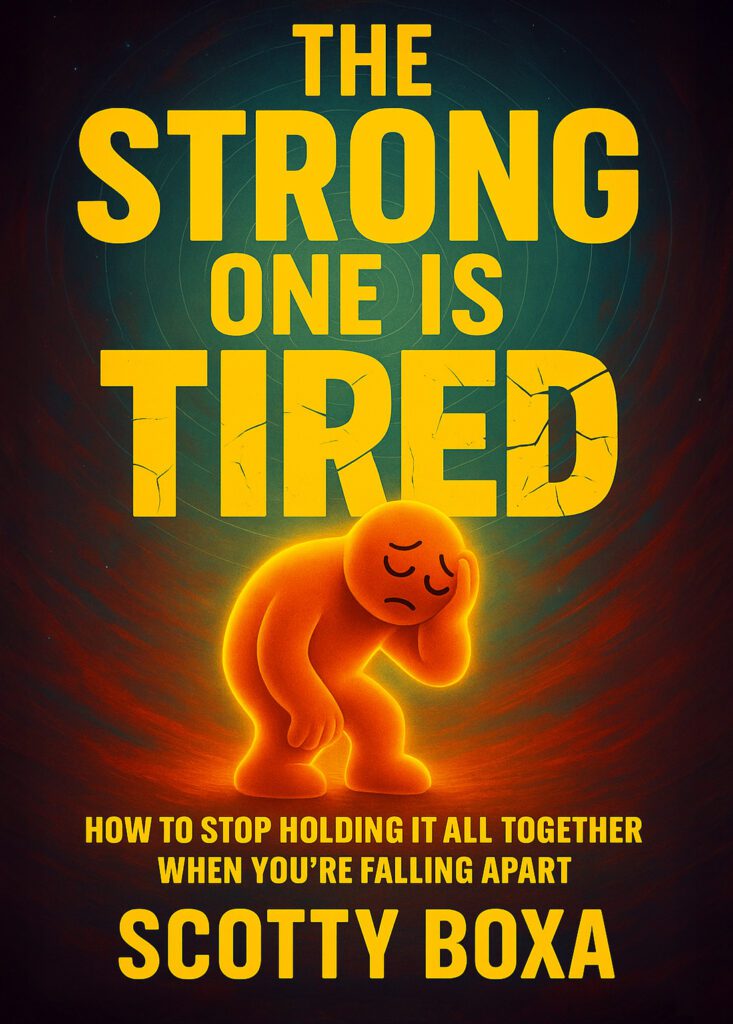
The Strong One Is Tired
How to Stop Holding it All Together When You’re Falling Apart. For the Burnt Out, Breaking Down, and Barely Coping.
Read the book page → Get on Amazon →