

The classic version of this advice is “hold your tongue.” Stay quiet. Do not say the thing. Pick your battles.
It is bad advice for most of the people most likely to follow it.
The people most likely to take the “hold your tongue” advice seriously are already over-holding their tongues. They are the same people who reply to texts in under four minutes, host the party they did not want to host, and quietly resent it for the next eleven months. Telling them to hold their tongue is telling a person who already cannot stop apologising to apologise less audibly.
The actual advice for that person is to hold their ducks.
What a duck is
A duck is something you are carrying that was never yours. Other people’s drama. Other people’s guilt. The favour you said yes to and now resent. The text you owe. The wedding you do not want to be at. The hens weekend in Bali your cousin asked you to organise for the third year running.
If you have ever stood in a Woolies car park crying about how much you have to do this week, the things you are crying about are mostly ducks. They are not yours. They never were. Somebody handed each of them to you and you said yes because saying yes was the thing you did.
You can put them down.
Three sentences from the book
These are from Hold My Ducks. They are the actual sentences. They work because they do not explain themselves. The minute you start explaining a no, you have re-opened the negotiation.
One: “Thanks, I’m not available for that.”
This is the master sentence. It works for any request. It does not say why. It does not promise to do it later. It does not apologise. It is the sentence the people-pleaser brain rejects most strongly, because the brain is convinced the other person needs the reason. They do not. They need the answer.
Try it on something low-stakes first. The colleague who asks you to grab a coffee on your way back. The cousin who asks if you can host Christmas this year. The friend who asks if you can listen for an hour about the same problem they have not done anything about for a decade.
Thanks. I’m not available for that. Then stop talking.
Two: “Let me get back to you tomorrow.”
For the requests where you cannot say no in the moment, this buys you the next twenty-four hours. The next-day rule. A yes given fast is almost always a yes you regret. A yes given after a sleep is almost always a yes you can stand behind.
Use this with the requests that come at the worst time. The text at 11pm. The call on a Sunday morning. The colleague who pops over to your desk in the last fifteen minutes of the day with a question that requires three hours of work. Let me get back to you tomorrow. Then sleep on it. Most of these requests dissolve before tomorrow because the person asking realises mid-Tuesday that they did not actually need you to do it. You bought them the realisation by not solving it for them.
Three: “I notice you keep asking.”
The repeat-offender sentence. Use it on the person who has been handed your “no” three times and is asking for the fourth.
I notice you keep asking. The sentence is doing two things at once. It tells them you noticed. It tells them you noticed without escalating. It is the lowest-stakes possible callout, and most repeat askers will hear it and stop without needing you to say anything else. The minority who do not stop are the ones you needed to remove from the rotation anyway.
The duck count
The book has a small, deliberately silly device for keeping track. You count the ducks. Every favour you said yes to and have not delivered on. Every text you have been meaning to send. Every unspoken obligation hanging in your head. Each one is a duck. Most readers, the first time they do this, count fourteen to thirty.
You cannot put all of them down at once. You do not need to. You need to put down two. Which two is up to you. The book has a chapter on which two to start with, but the spoiler is that you already know.
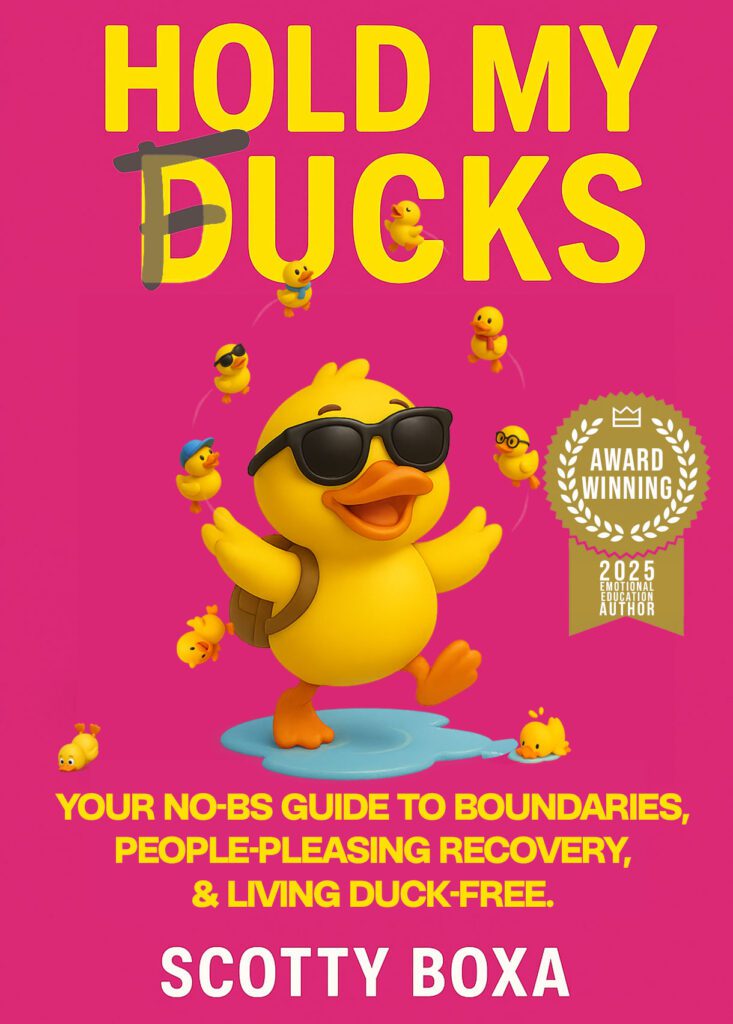
Hold My Ducks
Stop People Pleasing, Set Boundaries, and Reclaim Your Energy
Read the book page → Get on Amazon →