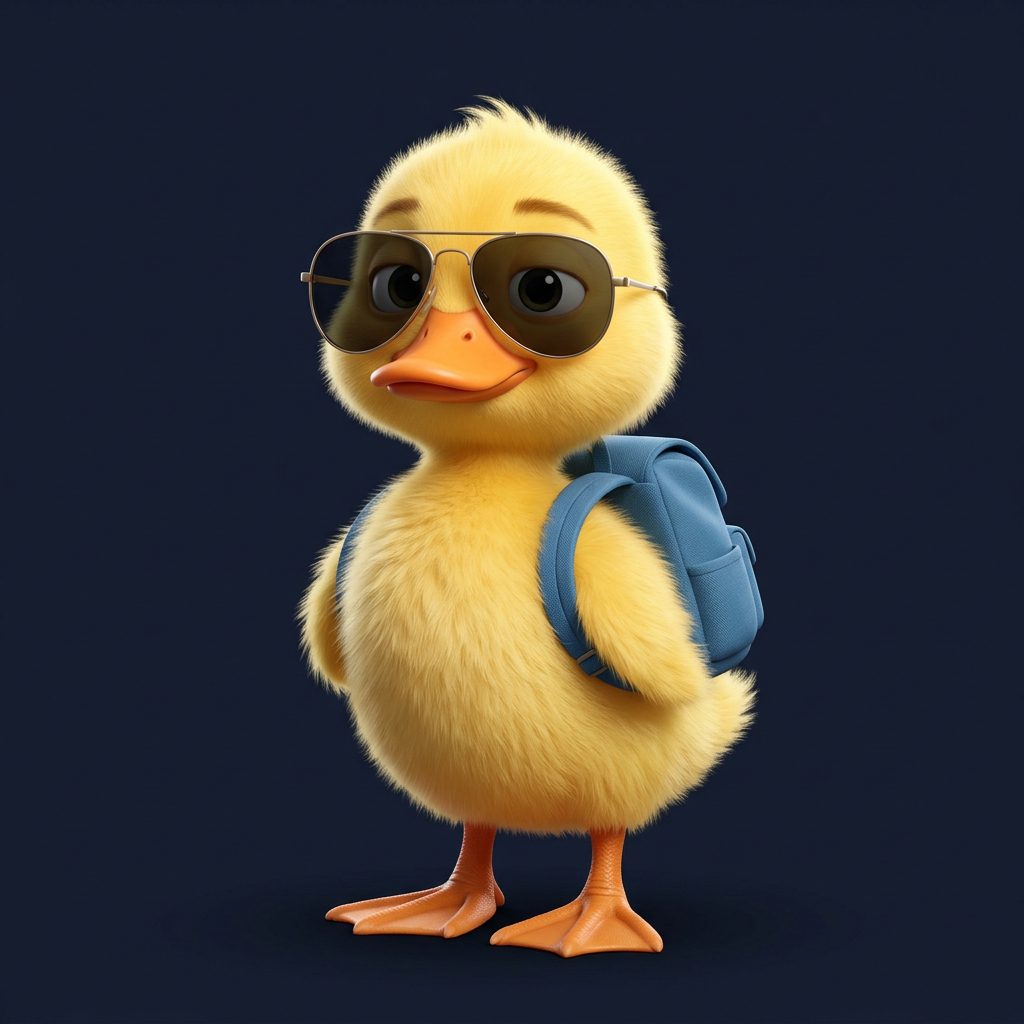
This is a piece about a duck.
The duck is in the title of one book, on the cover of all five, and at the top of the website. The phrase is “meet your emotional support duck.” Most people, when they first encounter the line, assume it is a metaphor.
It is not, in the standard sense. It is also not, in the standard sense, a joke.
The literal version
Yes, ducks have been registered as emotional support animals. It is technically a thing. There is at least one TikTok where a man takes his duck on an aeroplane. There is documentation. We are not making this up.
That is not what the Waddle Forward duck is for.
The practical version, before we get to the structural one
The honest answer to “why a duck” is much simpler than the abstract reasons we are about to lay out.
The books were originally going to be called something else.
Hold My Fucks. What The Fuck Am I Doing With My Life? Fuck Yeah. You can see the problem.
You cannot put the word FUCK on the cover of a paperback that needs to live on a shelf at Big W. Amazon would reject the title on day one. Mum could not buy it for her sister. The retailers would not stock it. The thing would never reach the actual reader who needed it.
So FUCK became DUCK. One letter. The whole title softened, the whole joke kept. Hold My Ducks. What The Duck. Duck Yeah. Try them out loud. They land harder than the originals, because now there is a small, baffled-looking yellow animal doing the work the swear word used to do, and that softness gives the line a second beat it did not have before.
Then the duck stuck. The substitution became a character. The character became a mascot. The mascot became the Emotional Support Duck. The rest of this article is about what the duck does once it is on the page. But you should know that the duck is the residue of a swear word, and the books still have that under-the-surface energy even when the title is family-friendly enough for Big W.
The structural version
The duck is a structural device. It is a placeholder for the difficult thing the reader does not yet have language for. The reader is carrying something. The thing has a shape, but no name. The thing has weight, but no words. The reader has been carrying it for a long time.
The duck is what we call that thing while we work out what it actually is.
This sounds abstract. In practice, it is not. The reader who picks up Hold My Ducks knows, by chapter two, that the ducks in the title are the unspoken obligations they have been carrying. The reader who picks up The Strong One Is Tired knows that the duck in the artwork is them. The reader who reads Duck Yeah knows the duck is the version of themselves they are trying to coax back to the kitchen. The duck does different work in different books. The duck does the same work for every reader, which is: it holds what the reader does not yet want to look at directly.
Why it matters that it is a duck
The mascot could have been a turtle. It could have been a frog. We considered a wombat for about six minutes in the early planning. The thing has to be a small, unthreatening animal that does not look like it is judging the reader. That is the design constraint. The mascot has to absorb feeling, not radiate it.
A duck does this better than most alternatives. The duck is small enough to be unintimidating. The duck has a face that looks calmly tired, which is the face the reader is most likely making. The duck waddles, which is the verb these books use for the kind of forward motion that is honest about its own awkwardness. We are not striding. We are not sprinting. We are waddling. Waddle forward.
The duck on every page of every book that matters is not a gimmick. It is a reading device. The reader can let the duck hold what they cannot hold themselves while they read. It works particularly well for readers who have a hard time letting the books be about them, which is most adult readers in this genre. The duck takes the weight off the reader long enough for the reader to take in what the page is saying.
What the duck is not
The duck is not a mascot, in the standard marketing sense. It does not sell anything. It does not have a tagline. It is not on a t-shirt yet, although the day is probably coming.
The duck is not a comic relief device. The books are funny, and the duck is on the cover, but the duck is not the joke. The joke is the genre. The duck is the place to put your hands while the joke lands.
The duck is not a metaphor. It is, more accurately, an inanimate emotional load-bearer. There is no English word for this, which is part of why the duck exists.
If you have a duck
If you have a duck, the books in the Waddle Forward series are for you. The series is built around the assumption that you have one. It treats the duck as a given, the way most self-help books treat the feelings as the given. The duck is the carrier. The feelings are still in there. The reader does not have to look at them directly until they are ready.
If you do not have a duck, give it a week.
The Waddle Forward Series is four books. Hold My Ducks for boundaries. What The Duck Am I Doing With My Life for direction. Duck Yeah for rebuilding. The Strong One Is Tired for burnout. The Collection is the three-book bundle. The duck appears in all of them. The duck does not change. The reader does.
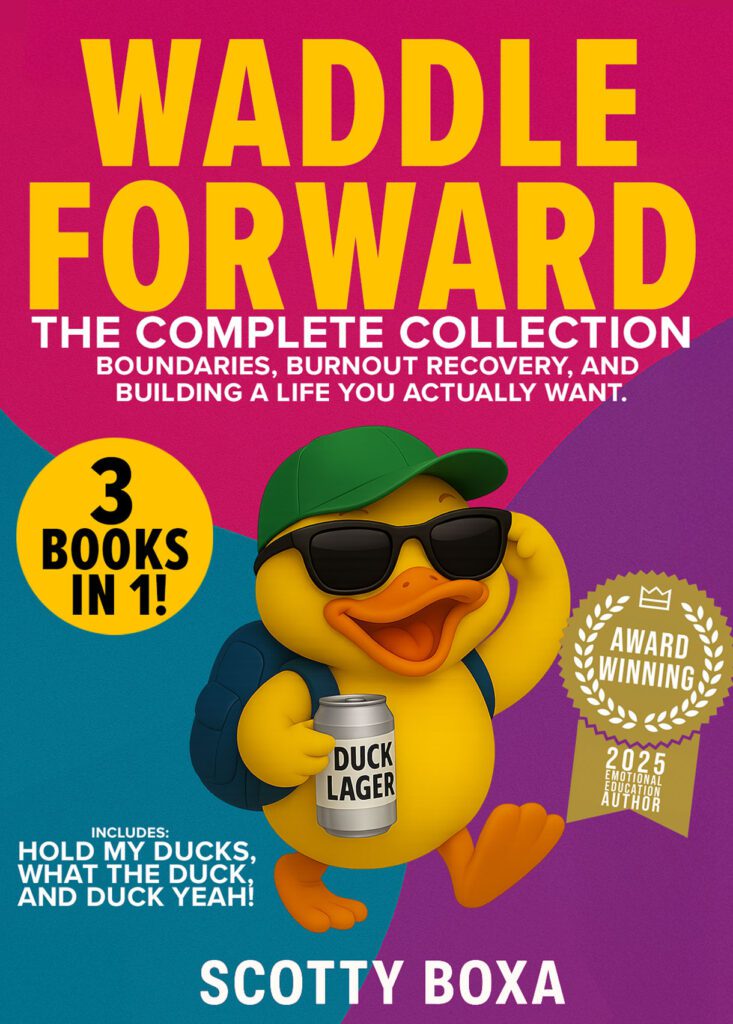
The Waddle Forward Collection
3 Funny Self-Help Books to Stop People Pleasing, Set Boundaries, and Figure Out Life Without Losing Your Sense of Humour
Read the book page → Get on Amazon →