This is a recommendation list for people who are sick of recommendation lists.
You have read the bestsellers. You own the journal. You did the breathwork for nine days. You bought the affirmation cards on a Tuesday in March, used them once, and lost them in a kitchen drawer somewhere behind the takeaway menus. You are not new to self-help. You are not allergic to it either. You are something in between, which is a tougher reader to write for than either of the extremes.
The genre is full of books written for people who have never read a self-help book. Almost nothing is written for the audience who has read all of them and walked away wondering whether the problem was them.
Here are ten that meet you where you actually are.
1. The Subtle Art of Not Giving a F*ck, Mark Manson
The book that earned the right to be on every list like this. Yes, you have probably read it. Re-read the chapter on values. The rest of the genre has not caught up to the framing Manson built there.
2. Untamed, Glennon Doyle
Memoir more than self-help, which is part of why it works. The genre’s honesty problem is partially Doyle’s. She made it harder for anyone after her to coast on platitudes. The cheetah passage in chapter two does what a hundred lesser books pretend to.
3. Atlas of the Heart, Brene Brown
If you have never read Brown, start here. If you have already read everything else of hers, start here anyway. It is the most underrated of her books, a working dictionary of feelings most adults have stopped naming.
4. How to Be Sick, Toni Bernhard
Not what the title sounds like. A Buddhist teacher writes about chronic illness from the inside of it. There is a chapter on caregiver burnout that is the single best paragraph on the topic anyone has written in this century, and most readers do not know it exists.
5. Bird by Bird, Anne Lamott
It is a book about writing. It is also a book about everything else. Lamott’s “shitty first draft” concept is a working philosophy for any version of a thing that has to start before it is ready, which is most things.
6. What My Bones Know, Stephanie Foo
A memoir of complex PTSD that refuses to make the recovery look clean. Foo writes the unglamorous part of trauma work that most books elide. The hardest book on this list. Also the one that pays off most if you finish it.
7. Duck Yeah, Scotty Boxa
This is mine. I am putting it at number seven because it would feel weird to put it any higher and dishonest to leave it off. Duck Yeah is the rebuild book in the Waddle Forward series. It is for the day after the worst is past, when the long part starts. If you have read every other book on this list and are still standing in a kitchen at 11pm wondering whether you have it in you, this is the one I wrote for that. Slow restarts win.
8. Tiny Beautiful Things, Cheryl Strayed
A column collected into a book. Strayed answered letters from readers as “Dear Sugar” for years and her answers became one of the great accidental self-help libraries of the 21st century. Read it cover to cover or open it at random. Both work.
9. What Happens at Night, Heather Havrilesky
An advice columnist writing about marriage in midlife. The voice is sharp in a way self-help rarely allows itself to be. Havrilesky earns every line.
10. Quiet, Susan Cain
Not new. Not trendy. The argument for introversion as a strength, not a deficit. The closing chapters are the part most readers forget about, and they are where the book does its real work.
What to do after the list
Read one. Not two. Not the whole stack. Pick the one that landed and stay with it until you are done. The reading-too-much-self-help problem is real and the cure is reading one book well, not three at once.
If any of these sounded like the book you wish someone had written, the closest one I have read is the one I wrote. Make of that what you will.
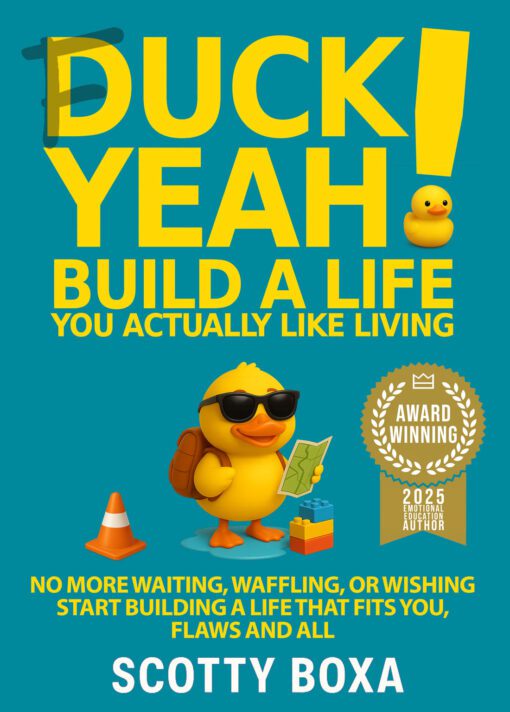
Duck Yeah
Build a Life You Actually Like Living. A Witty Guide to Getting Unstuck, Rebuilding Your Life, and Actually Enjoying Your Life Again.
Read the book page → Get on Amazon →