

Doing less is harder than doing more.
This sounds like a self-help platitude. It is not. It is a description of a real problem, which is that the people most likely to need to do less are the people whose entire identity is built on doing more. Tell them to do less and you have asked them to take down a load-bearing wall in the house they live in.
This article is the small instruction manual for doing that.
Why the guilt comes
The guilt is not random. The guilt is the price you pay for breaking a contract you signed with yourself a long time ago. The contract said: you are worth what you produce. The guilt is the contract trying to enforce itself.
You cannot break the contract by just not producing. You break the contract by replacing it with a new one. The new one says you are worth something other than what you produce. That is the work the books usually call “self-worth” and that you have already heard about a hundred times and that has not stuck because nobody told you it was a contractual renegotiation.
What “less” actually means
Less does not mean nothing. Less means an honest accounting of what is actually load-bearing in your week versus what you have agreed to carry out of habit.
Take the list of things you did last week. Cross off everything that was either (a) genuinely necessary for survival or (b) genuinely energising for you. What is left is the surface area you can prune. Most readers find that surface area is between 30 and 60 percent of their week. They are not exaggerating. They are also not lying when they say they cannot give it up.
The three steps
Step one is to identify one item from the surface-area list and decide to not do it this week. Just one. Just this week. Pick the smallest one.
Step two is to sit with the guilt that comes. The guilt will come. It will be disproportionate. It will tell you stories about how the world will fall apart if you do not do the thing. Notice the stories. Do not argue with them. Just notice them.
Step three is to do this every week for a month before adding a second item to skip. You are training a nervous system that has been on full alert for two decades. It needs a slow restart. Slow restarts win.
The book that is about this
Duck Yeah is the rebuild book in the Waddle Forward series. It is for the moment after the worst is past, when the long part starts. The premise of the book is that rebuilding is not done in big dramatic motions. It is done in many small ones, repeated, with rest, over a long enough timeline. The book is what to read when you are doing less and waiting for your brain to catch up to the new reality.
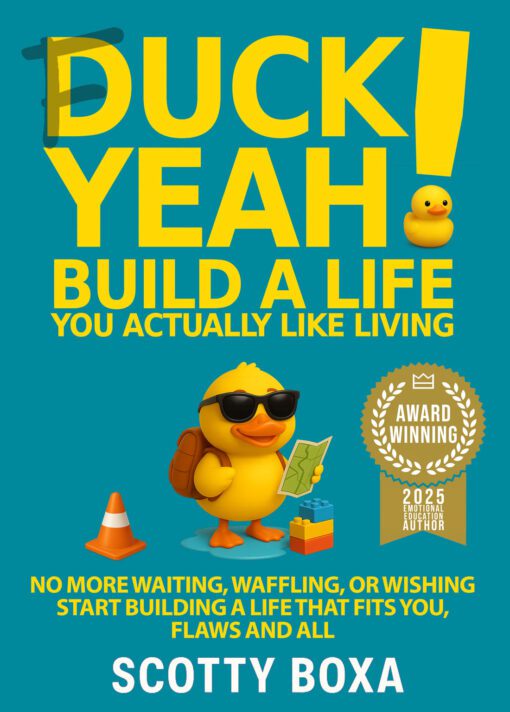
Duck Yeah
When the worst part is past and the long part starts.
Read the book page → Get on Amazon →